
Summer, 2001
Marching band started the same way it always did: on a blistering Georgia parking lot, with the sun already high enough to make the asphalt shimmer and the brass too hot to touch.
I was fifteen — a sophomore — and somehow I had been named a trombone section leader.
Most of the officers were seniors. They had been here longer. They had earned their place through years of rehearsals, competitions, bus rides, and football games. They knew the culture, the inside jokes, the unspoken rules.
I didn’t.
When the director read the list, I felt the temperature of the entire band shift. Not dramatically — just enough to notice, just enough to know this wasn’t going to be easy. There was a polite clap, a few raised eyebrows, and a couple of sideways glances from people I respected.
“Why him?”
Nobody said it out loud, but I heard it anyway.
Being a section leader wasn’t about playing first chair — and I certainly wasn’t that. It was about trust, and I didn’t have any yet.
The first few rehearsals were awkward in the way only teenage leadership can be. I tried to sound confident while counting off warmups I barely felt qualified to lead. I over-explained because I was afraid of being wrong. I hesitated before correcting mistakes because I didn’t want to look arrogant. Sometimes I commanded with too much haste and still made the wrong calls.
Every time I spoke, I could feel the room deciding whether I deserved to be listened to.
The seniors in my section weren’t unkind, but they were skeptical. They didn’t push back or undermine me — they simply waited. Waited to see if I would crack. Waited to see if I would fold under pressure. Waited to see if I was actually worth following.
That summer taught me my first uncomfortable lesson about leadership: you don’t get authority because someone gives you a title.
You get authority when people decide they can trust you.
And trust isn’t built in speeches. It’s built in the smallest, most boring moments — showing up early, knowing the drill, owning mistakes, doing the work no one sees, protecting your people when things go wrong.
I didn’t know any of that yet. All I knew was that I had a trombone section, a binder full of drill charts and sheet music, and a season ahead of me to figure it out.
There was one person I watched closely that summer:
the other trombone section leader, a senior who everyone trusted. On paper we had the same role. In reality, he had the experience, the history, and the credibility — and I had the title.
He never made that awkward. He didn’t compete with me or undermine me. He just did the work. He showed up early, knew the drill cold, and stood beside the freshmen who were about to miss their backwards eight-to-five before they missed it. When someone messed up, he fixed it beside them — not above them. When I stumbled, he backed me up instead of stepping in.
I learned what leadership looked like by watching him. Not the big gestures, but the small, unglamorous ones: being prepared, being patient, being kind, being consistent.
So I copied him. I stopped trying to prove I deserved the role and started trying to deserve it. Slowly, the section stopped asking “Why him?” and started asking “What do we need to do next?”
By the time football season arrived, everything felt different.
The chaos of summer band had burned off and something steadier had taken its place. We weren’t just surviving rehearsals anymore — we were building a show.
Friday nights came fast: the smell of cut grass and popcorn, the thump of bass drums echoing through the stadium tunnel, the low hum of nervous teenagers pretending not to be nervous.
The trombone section moved like a single organism. We hit our sets, locked in our horn angles, and cleaned transitions until they felt automatic. I didn’t have to bark instructions anymore. Someone would quietly say, “Two steps left,” and the correction would ripple through the line without drama.
We trusted each other.
And for the first time, I felt something click that I didn’t have words for yet: this is what it feels like when a system works — not perfect, not effortless, but resilient. When one person stumbled, another covered. When someone missed a cue, the rest held the line. Leadership stopped feeling heavy and started feeling shared.
The first time it really mattered, it happened in about half a second.
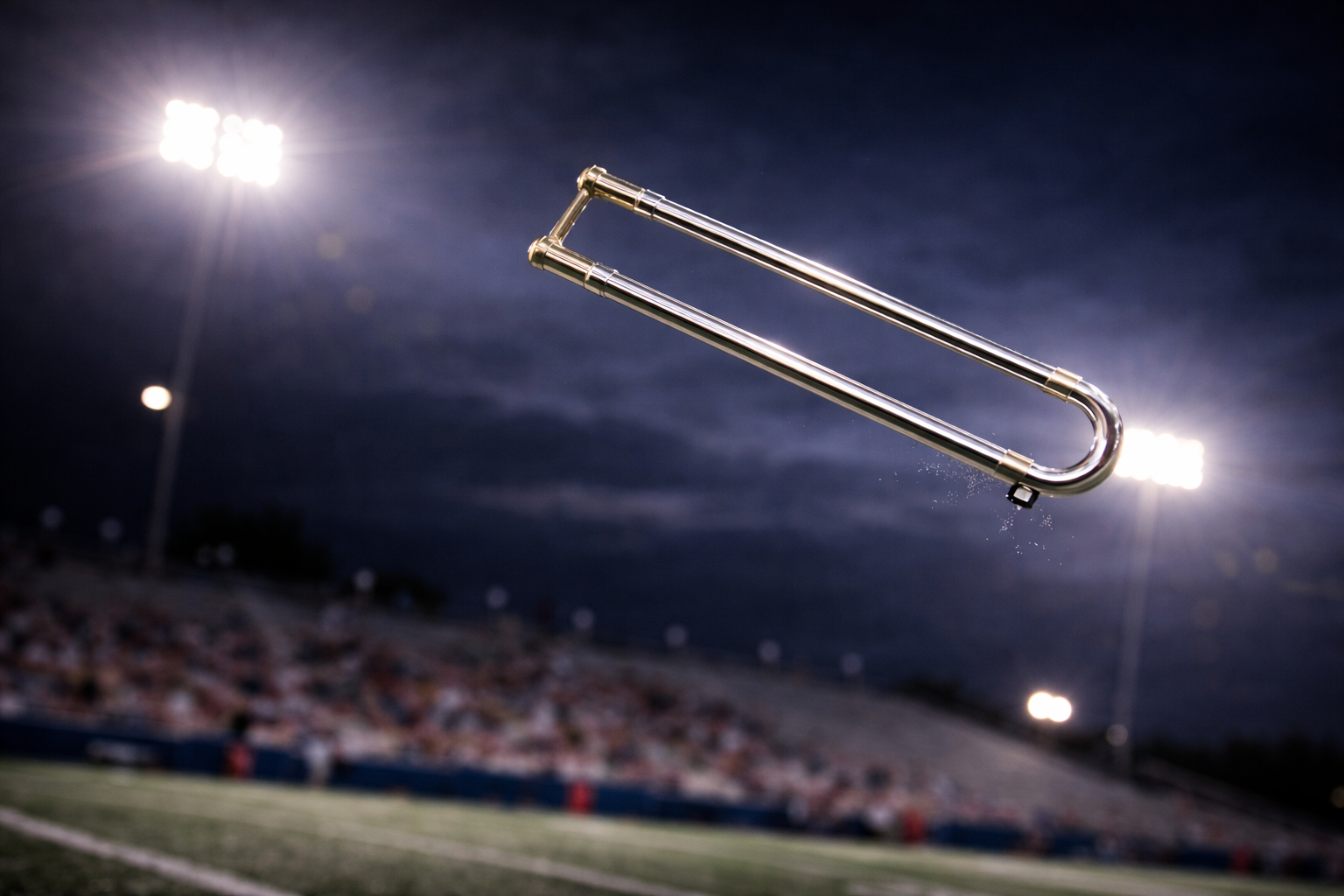
Midway through the halftime show — a fast brass feature with lots of movement and big visual moments — I came out of a turn, drove the trombone to fifth position, and my right hand closed on nothing.
The new gloves were the problem. They looked great — white, sharp, very official — but the inside was slick, not grippy like the pair I’d worn all season.
And I was a nerd about slide care. I cleaned it every week. Used the good stuff. Water spray. Perfect action.
So when my hand missed, the slide didn’t hesitate. It launched — a silver-gold blur skidding across the 50-yard line like a tiny, extremely well-engineered projectile weapon.
For a fraction of a second my brain just stopped. Then everything came back at once: the crowd, the music, the line, the fact that I was the section leader currently missing half of his instrument, and the fact that the band does not stop.
So I broke formation
scooped the slide off the turf, jogged back into my set, and kept playing. For a few measures I was just air and stubbornness — no slide, no notes, just muscle memory. The set was almost over and my stomach was in free fall.
I jammed the slide back on. Upside down. Pulled it off. Flipped it. Seated it properly.
And somehow landed the final note with the rest of the section like nothing had happened.
From the stands it probably looked fine. From inside my head it felt like a small, very public disaster.
The moment we cleared the field, the tension evaporated.
Someone clapped me on the shoulder. Someone else handed me a water bottle — and then the laughter started. Not cruel, not mean — the good kind that only comes from shared chaos.
“Did your slide just… leave the building?” “I saw it take flight.” “I thought it was part of the show.”
By the time we were back in the band room, people I barely knew were stopping me in the hallway. Even the cute girls were in on it.
“Lose anything last night?”
I was absolutely mortified — and quietly, kind of proud. Because the band didn’t fall apart. Because nobody blamed me. Because we recovered.
That night I learned another lesson I didn’t know I needed yet: if you can’t laugh at your own failure, you’ll never survive leadership. Embarrassment fades. Humor builds trust.
And the people who laugh with you today will follow you tomorrow.
Years later, I’d stand in data centers and war rooms and Kubernetes dashboards and feel that same quiet pressure I felt under those stadium lights.
The tools changed. The stakes got higher. The crowds got smaller and more opinionated.
But the systems behaved the same.
They still failed in public. They still refused to stop when you wanted them to. They still demanded calm, preparation, and people who trusted each other when things went wrong.
Most of what people call my “leadership style” was shaped long before I ever wrote a line of Terraform or stood up a Pulsar cluster.
It was shaped on a sun-baked parking lot in Georgia. By a senior trombone player who showed me how to lead without ego. By a section that taught me that trust is built in small, boring moments. And by a silver slide skidding across the 50-yard line that taught me how to fail in public and laugh anyway.
I still try to lead the same way.
Show up early. Do the unglamorous work. Protect my people. Own my mistakes. And when something goes wrong — because it always does — keep playing.
Sometimes it’s good to look backward to understand who you’ve become.
Because the man you see today was built long before the first incident call ever started.