The year was 2005...
I had just started my career as a datacenter technician. There was still hardware humming away from the late ’90s—beige metal, yellowed labels, SCSI drives that sounded like they were chewing gravel—and I was suddenly responsible for keeping my own little slice of the internet alive.
It wasn’t glamorous. My world was a narrow corridor of raised floors, cold aisles, and cabinets filled with machines older than some of the people supporting them. Every rack had a history. Every cable had a story. Some of them were lies.
The data center didn’t look dangerous. It was quiet, sterile, even comforting in a way. Blue LEDs blinked in steady rhythms. Fans pushed cold air through perforated tiles. On the surface, everything felt controlled. Predictable. But that was the illusion. Underneath the floor tiles and behind the locked rack doors was a fragile web of power, copper, fiber, and human memory—and it only worked because nothing had gone wrong recently.
I was handed a badge, a set of keys, and a stack of documentation that might as well have been folklore. Diagrams drawn by people who had moved on. Labels written in fading Sharpie. Spreadsheets that hadn’t been updated since a server was considered “new” if it had more than one core. This was the map I was expected to use when things broke, and things were always breaking.
You don’t really learn a data center. You survive it long enough to start recognizing its moods. Which racks ran hot. Which PDUs were overloaded but not tripping—yet. Which switches had ports you didn’t touch unless you wanted to explain yourself to five different teams. It was less like managing infrastructure and more like tending a haunted house that powered websites, databases, and businesses people depended on.
And this was before “the cloud” meant anything. There was no abstraction layer. No safety net. If something went down, it was because a real piece of metal had failed, or a real human had made a very real mistake. Somewhere, a fan was dying, a power supply was about to pop, or a fiber jumper was hanging by just enough light to pass packets—until it didn’t.
This was my introduction to the internet: not as code or protocols, but as a physical place. A place built out of steel and air and electricity. A place that never slept, and never forgave.
My first real horror moment didn’t come from a failed server.
It came from the building itself.
The old Atlanta high-rise we were in started shedding its facade. Bricks fell into the parking lot below, and one morning we were told to evacuate while engineers decided whether the structure was still safe to occupy. When we were finally allowed back in, the repairs began—and they didn’t stop for months.
Jackhammers drilled into brick and concrete every day. The sound echoed through the halls, through the ceilings, through the racks. Fine red dust hung in the air no matter how much the cleaners tried to keep up. We all knew it was bad for the office, but no one thought about what it was doing to the machines quietly breathing that air nonstop.
Then one night, the temperature alarms started going off.
Our main fifty-ton air conditioner—the one that kept an entire data hall alive—had stopped working. Not degraded. Not limping. Dead. As the cooling failed, the laws of thermodynamics took over, and the data center began to cook itself. The temperature passed 90. Then 100. Then kept climbing.
When the HVAC technicians finally got access to the unit, they found the reason immediately. The air handler feeding that massive system was completely packed with brick dust. Months of drilling had filled it like a lung breathing in a demolition site. The airflow had been choked to death.
By the time we realized what was happening, the damage was already done.
SCSI and IDE hard drives started dropping out first. Bearings seized. Platters warped. One by one, disks that had been spinning for years simply gave up. Then things got worse. It was hot enough to start degrading fiber optic cable—something most people don’t even realize is possible. Links that had been rock solid began flapping, then going dark entirely.
I spent that night in a data center that felt like a kiln, rebooting servers, swapping dead drives, trying to coax dying machines back to life. Sweat ran down my back as I worked through rack after rack, praying that whatever was still spinning would keep spinning long enough to save what it held.
We worked through the night. Then into the next day. Eventually, we got the customers back online. Websites came back. Databases reappeared. The internet healed itself just enough for people to go on with their lives.
But not everything made it.
There was data that never came back. Entire slices of history erased by heat, dust, and a building that was quietly falling apart around us.
And that was when I learned something no monitoring system will ever tell you:
Sometimes, the thing that kills your infrastructure isn’t inside the rack. It’s the world pressing in on it from the outside.
After that night, I stopped believing in the idea of clean failures.
Textbooks and vendor diagrams love to show neat boxes with arrows between them. If something breaks, it’s a line going red. A component fails. An alert fires. You replace the part. Reality doesn’t work that way. Reality is messier. Failures leak. They spread. They hide inside other failures until everything feels haunted.
The heat didn’t just kill hard drives. It weakened power supplies that wouldn’t fail until weeks later. It warped connectors just enough to create intermittent errors. It stressed fibers that would look fine until the next time someone opened a door or bumped a tray. For months after, we were chasing ghosts—machines that rebooted for no clear reason, links that dropped only under load, disks that passed every test until the moment they didn’t.
That’s the quiet horror of physical infrastructure: damage has memory. You can’t roll it back. You can only wait for it to surface.
We called it “flakiness.” That polite little word engineers use when the truth is too ugly to say out loud. Flaky servers. Flaky links. Flaky power. But nothing was actually random. Every glitch was a delayed echo of that night when the room had turned into an oven.
And no dashboard told you that.
Monitoring can show you what’s broken. It can’t tell you what’s been wounded.
From that point on, every time I looked at a perfectly green status page, I wondered what invisible stresses were already building underneath it. Which fans were running hotter than they should. Which disks were still spinning only because they hadn’t been asked to spin too hard yet. Which cables were one vibration away from becoming a problem.
This is the part people don’t understand when they talk about uptime. A data center isn’t a machine. It’s an ecosystem. When you shock it—heat it, starve it of air, drown it in dust—it doesn’t just recover. It adapts. Sometimes badly.
That’s why the scariest outages aren’t the ones where everything dies at once. Those are almost merciful. The worst ones are the slow burns. The weeks of intermittent failures. The tickets that never quite line up. The creeping sense that something is wrong, but you can’t prove it yet.
You don’t just fix those outages. You live inside them.
What finally turns a wounded data center into something truly dangerous isn’t the hardware. It’s the people who have to touch it.
By the time something is broken badly enough to need human hands, the environment is already hostile. It’s loud. It’s hot. It’s cramped. You’re working in aisles barely wide enough to turn around in, surrounded by machines that are still very much alive and very angry about it. Every fan is screaming. Every cable is under tension. Every label is suspect.
And you never walk into a clean situation.
You walk into a web of “temporary” fixes that became permanent because no one ever had time to go back. Patch cables that were supposed to be replaced during a maintenance window that never came. Power whips added to overloaded PDUs because “just one more server” was always needed. Fiber run through places it was never meant to go because the original tray was full.
Then you add people.
Night shift techs who have never seen the system before. Remote hands reading instructions from someone who wrote them at three in the morning. Contractors who don’t know which racks are sacred and which ones are expendable. Everyone is doing their best, but the map they’re using is a lie.
Labels fade. Documentation drifts. What the spreadsheet says and what’s actually plugged in slowly diverge until they’re only loosely related.
This is how you end up with a cable that “shouldn’t matter” taking down half a cluster.
This is how you pull a fiber you thought was dead and suddenly three teams are on the phone asking why their services just disappeared.
This is how redundancy quietly erodes until it’s mostly ceremonial.
And the worst part is that when it happens, no one is trying to be careless. They’re trying to be fast. They’re trying to be helpful. They’re trying to fix something that is already broken. The system doesn’t collapse because of malice. It collapses because of pressure.
That’s the real enemy in a data center: urgency.
When everything is calm, you can be careful. When customers are down, you move. And when you move inside a system that’s already been weakened by heat, dust, vibration, and time, every action has consequences you can’t fully see.
I learned early on that most outages don’t start with a bang. They start with someone saying, “It should be safe to unplug this.”
And sometimes it is.
Until it isn’t.
A few years later, we moved into what was supposed to be a better building. Newer. Cleaner. Safer. We told ourselves the ghosts had been left behind in the old place.
It was January 2011.
We had learned some lessons from the heat disasters of the past, so the data center had been outfitted with spot-cooler water lines—three-inch copper pipes feeding supplemental air conditioners in the parts of the room that always ran too hot. They were a safety net for the brutal Georgia summers, when even the main HVAC struggled to keep up.
In the winter, though, we shut them down. No sense running chilled water when it was already cold outside.
What we didn’t control was how those lines had been installed.
The contractors who ran the pipe from the building’s water tower never put an accessible disconnect valve on our side. The shutoff lived somewhere deep in an ancient closet that only building engineering had keys to. We knew it was bad design. We just didn’t realize how dangerous it was yet.
Those copper lines ran through our air handler room — a space that was open to outside air. On most days that was fine. That night, it wasn’t.
One evening the temperature dropped to minus seven degrees Fahrenheit.
Inside that air handler room, the pipe froze solid. At the weakest point — the ball valve on our end — the expanding ice did what physics always does. It cracked the joint. When it failed, the pressure shot the steel ball inside the valve like a bullet, punching straight through a panel of sheetrock.
But we didn’t know any of this yet.
When the temperature rose back above freezing, the ice turned into water.
And the building’s water tower began emptying itself through a broken three-inch pipe into our air handler space.
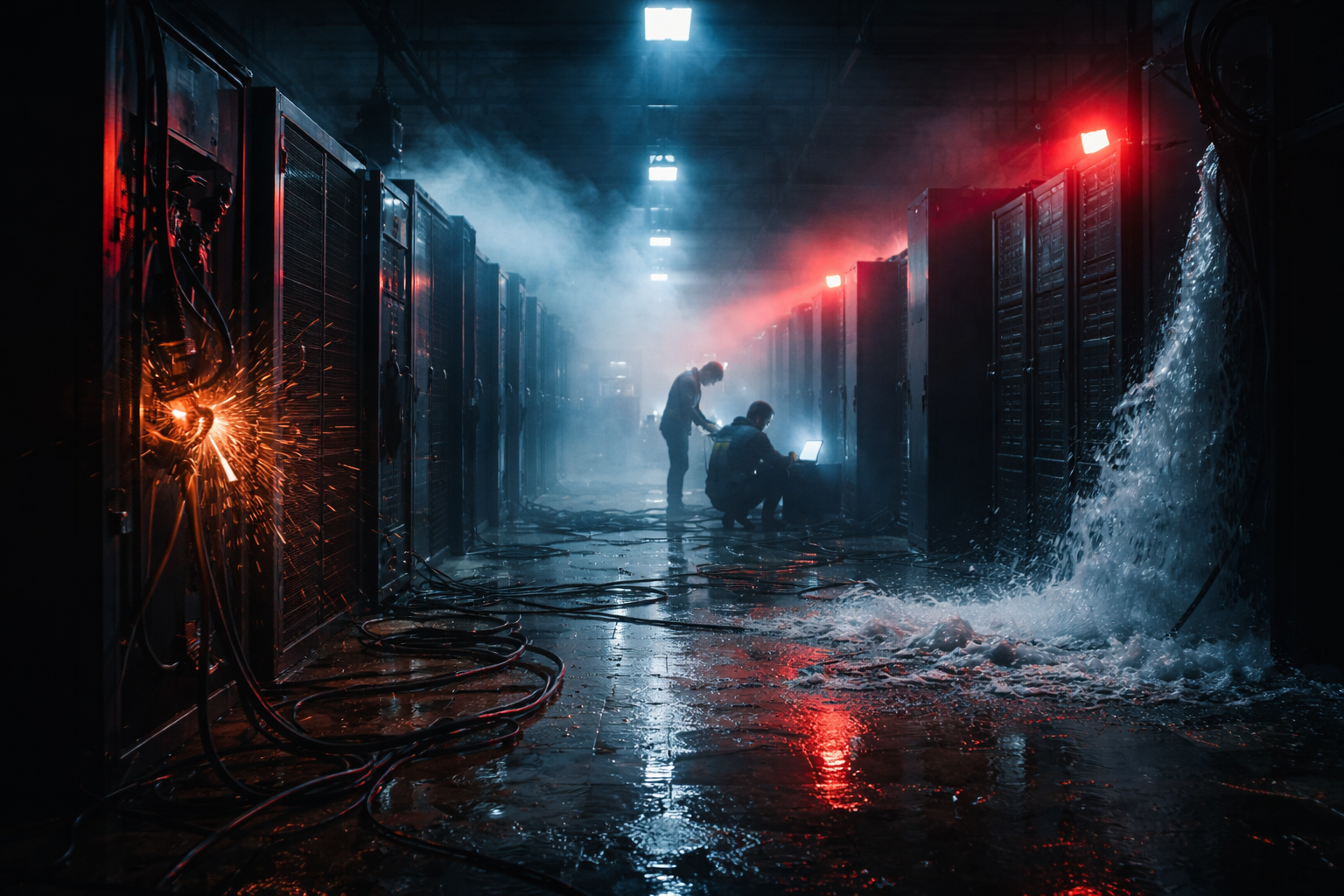
Tens of thousands of gallons poured out. It cascaded through the room, out the side of the building, and down into the street like a man-made waterfall. All of it feeding from a system we couldn’t shut off ourselves.
We didn’t own a valve. We didn’t have a switch. We didn’t even have access to the closet that could stop it.
Somewhere above us, gravity was trying to turn our data center into a floodplain.
We realized what was happening before we fully understood it.
Someone noticed water where water had no business being. Then more of it. Then the sound — a low, constant roar that didn’t belong in a room full of fans and compressors. By the time we traced it back to the air handler space, the truth was already ugly.
The building’s water tower was emptying itself through our broken pipe.
We called building engineering in a panic. They showed up furious, half-awake, already assuming we had done something reckless. From their point of view, this was our equipment, our cooling lines, our disaster.
But the part that mattered — the part that could stop it — wasn’t ours at all.
The only shutoff valve for that three-inch line was locked behind a door we didn’t control. It lived in a forgotten closet, somewhere deep in the building’s guts, accessible only to the people now yelling at us for a problem we couldn’t physically fix.
Oh and they were angry!
So we stood there together — angry engineers, soaked floors, alarms screaming — while water kept pouring out of a system none of us could touch.
It took precious minutes to find the right key, the right hallway, the right rusted valve behind a stack of abandoned junk. When they finally got it closed, the damage was already done. The water had gone where gravity wanted it to go, and gravity does not care whose fault it is.
Later, after the mess was contained and the accusations died down, the truth was quietly obvious: this wasn’t a freak accident. It was a design failure that had been waiting for cold weather and a weak joint to expose it.
No one had installed a safe, accessible disconnect. No one had thought about freezing. Everyone had assumed someone else owned the risk.
That’s how data centers really get hurt...
Not by a single mistake, but by responsibilities that fall into the cracks between teams.
Fire and flood. Heat and ice. Two disasters, years apart, caused by completely different things, but tied together by the same uncomfortable truth: the physical world is always trying to reclaim your infrastructure.
We like to pretend data centers are sealed bubbles of control. We talk about redundancy, availability zones, and disaster recovery as if they live entirely in diagrams and dashboards. But every one of those abstractions ultimately rests on a building, a power feed, a cooling loop, and a set of assumptions about how the world will behave tomorrow.
The first time, it was heat. Brick dust choked the lungs of a fifty-ton air conditioner and turned a room full of servers into an oven. The second time, it was cold. A frozen pipe turned a water tower into a fire hose aimed straight at our air handlers. In both cases, the failure wasn’t exotic. It wasn’t some rare cosmic event. It was physics doing exactly what physics always does when you give it the opportunity.
What made those moments terrifying wasn’t just the damage. It was how little control we actually had when things went wrong.
We didn’t own the building. We didn’t own the shutoff valves.
We owned the responsibility for the outcomes.
That’s the quiet horror of data centers: you are accountable for systems that depend on people, processes, and infrastructure far outside your authority. A mislabeled breaker. A forgotten closet. A contractor who didn’t think about winter. A repair crew that didn’t think about dust. Any one of them can undo years of careful engineering.
And when it happens, customers don’t see brick dust or frozen pipes. They see outages. They see missing data. They see broken promises.
Over time, this is why the industry moved toward abstraction. Toward cloud. Toward managed services. Not because we stopped caring about hardware, but because we learned how dangerous it is to be too close to it. The farther you are from the fans and the water and the power, the fewer ways the universe has to surprise you.
But even now, those same forces still exist. They’re just hidden behind someone else’s badge and someone else’s keys.
Somewhere, a data center is getting too hot. Somewhere, a pipe is freezing. Somewhere, a technician is trying to figure out which cable is safe to unplug.
And if things are going well, you will never hear about it.
That’s the unsung horror — and the quiet heroism — of the people who keep the lights on.